What’s the worst decision with long-term consequences in American sports history? The Red Sox trading Babe Ruth to the Yankees? The Portland Trailblazers passing on Michael Jordan and instead selecting Sam Bowie with the second pick of the 1984 NBA draft? Nico Harrison trading away Luka Dončić?
Hindsight is 20/20, and I’m sure each of the decisions listed above were made after intense contemplation and scrutiny from several parties involved.
But players in history aren’t judged on how they weighed the pros and cons of a major decision. Judgement is delivered based on how said decision unfolds, what were the benefits or gains of it, and what did it cost in the end.
President Lyndon B. Johnson claimed he felt trapped by whether to give the go ahead for boots on the ground in Vietnam, something akin to a Chinese finger trap: the harder you press, the worse it gets. History continues to judge LBJ quite harshly to this day over his giving of the green light. 10 years later, 58,281 American dead with 303,644 wounded, I think judgement is duly warranted.
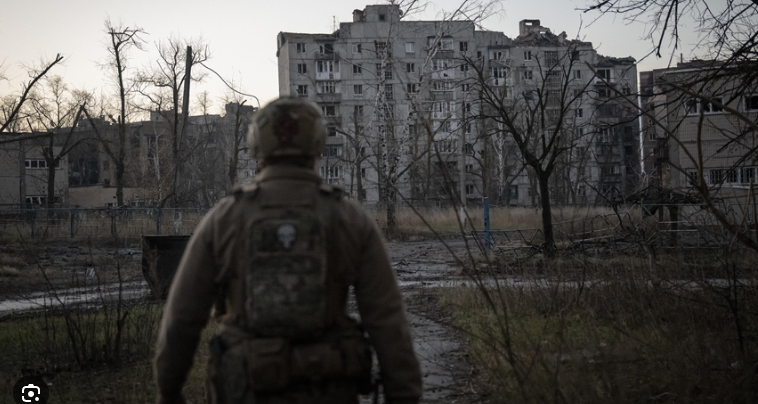
We recently passed the fourth anniversary of Russia’s February 2022 invasion of Ukraine. The most destructive war on the European continent since WWII continues to grind on with neither side holding a decisive edge over the other.
As of the writing of this post, 1,467 days have passed since the first Russian tank crossed the border toward Kyiv. For reference, it took 1,415 days from the beginning of Operation Barbarossa (Nazi Germany’s invasion of the Soviet Union in June 1942) to Germany’s surrender in May 1945, which led to the deaths of 25 million people. On June 11 of this year, the current Ukraine-Russia conflict will have lasted longer than the First World War.
These morbid milestones led me to an interesting article from the Center for Strategic and International Studies (I’ll never stop promoting CSIS, they do great work). Vladimir Putin launched this operation in the belief that Ukrainian resistance would disintegrate, their leadership captured, and full Russian control would be established in the capitol within 72 hours. The following charts explain how his decision has played out.
Russia Has Suffered an Unprecedented Number of Fatalities
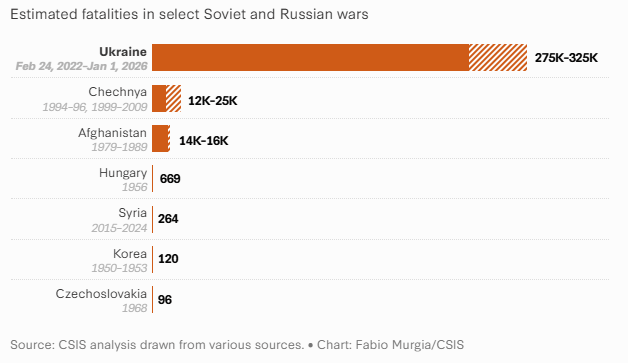
Assessing casualties in wartime is a difficult endeavor for a couple reasons 1) war is chaos 2) both sides have incentive to inflate or shrink the numbers for political purposes. The Russian Ministry of the Defense (MoD), Ukrainian MoD, and U.S. State Department all tally differing numbers when it comes to Russian losses, hence the above range of 275K-325K estimated battlefield dead.
But try to wrap your head around that figure. Three fully packed SEC sized stadiums of people in an age of warfare that many thought had left casualty numbers of this magnitude behind.
Just so we’re clear on the term “casualty”, it means any combatant that has been killed, wounded, captured, deserted, or missing, essentially no longer able to fight. That figure above isn’t number of casualties, it’s fatalities. Estimated Russian casualties currently stand at greater than 1.2 million, more than the population of Rhode Island.
In 2025 alone, the State Department published a report detailing estimates of 415K casualties including 100K-130K deaths. Think back to that paragraph on American casualties in Vietnam. The Russian Army suffered twice the amount of deaths in Ukraine in 12 months of fighting than the United States did in 10 years of active combat in Vietnam.
There’s another detail about the above statistics I want to point out that gives a different perspective. The death to total casualty ratio is a stat that measures the amount of killed on the battlefield as compared to the total casualty rate. For reference, the United states suffered a death-to-casualty ratio of 1:7 in Iraq and 1:8 in Afghanistan, in Vietnam it was 1:5, and during the Second World War 1:2. If you think deeply about it enough, you see a clear trend here. As time has progressed, combat medicine both on the battlefield and at field hospitals off the battlefield has improved by orders of magnitude leading to typical wounds no longer being fatal. Additionally, methods of evacuating casualties off the battlefield have changed dramatically over the last 80 years, none more so than the application of helicopters.
As it stands, Russia is staring down the barrel of a 1:4 ratio in Ukraine. By modern standards, this ratio describes an underfunded rebel force fighting in Syria, not what many considered the most powerful land army in Europe four short years ago.
The discrepancy between the Russian and American figures can be explained in a few ways:
- The United States military goes to great lengths to give the best battlefield medical attention in existence, not just in the training of its medics, but also the dedication of whole detachments of very expensive helicopters for the sole purpose of evacuating wounded. This isn’t just done for ethical reasons (which of course is the primary reason), but also each soldier is seen as a huge investment of time and resources (~$400,000 over the course of 4 years of enlistment, on average) that is not easily replaced.
- A large portion of Russian forces currently in Ukraine are a result of multiple different conscription efforts to plug gaps. There were reports of prisons being emptied to fill the ranks of Russian units devastated by attritional warfare. In short, Moscow doesn’t view the loss of these soldiers as inherently tragic, cannon fodder is thrown around too often but may legitimately apply here.
- The nature of the war lends itself to high death rates. The war has devolved into one that is both highly attritional and static. The advent of major drone use at the squad level has turned the battlefield into an ocean of sensors. It is impossible to move out in the open without being spotted immediately. Units are forced to limit movement as much as possible to hide from hordes of drones that stalk the frontline. Because of this, Russian leadership refuses to risk valuable assets such as armored vehicles or helicopters for medevac purposes. Every day men die from treatable wounds sustained in their trenches who would have otherwise survived long enough to make it to a field hospital 10 years ago.
With the spring fighting season rapidly approaching, Russian casualties are expected to eclipse 1.5 million by mid-2026.
Russia Is Advancing at Historically Slow Rates
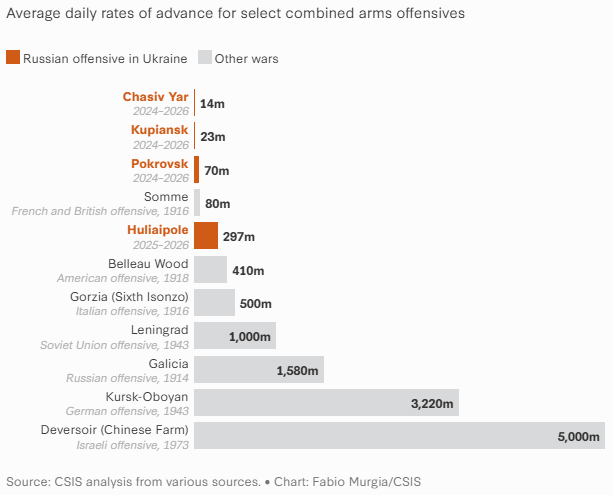
Russia’s slow rate of advance in multiple offensives over the last two years underscores the attritional nature of the war in Ukraine and the difficulty of breaking through fortified defensive positions. Here’s a quick anecdote to drive this home:
- After Russia won control of the city of Avdiivka in Donetsk Oblast in February 2024, Russian forces began a sustained offensive aimed at the nearby city of Pokrovsk, a key logistics and transportation hub that supported Ukrainian operations across the eastern front line. The offensive relied on infantry assaults, heavy artillery shelling, drone attacks, and glide bomb strikes to erode Ukrainian positions. From late February 2024 to early January 2026, Russian forces advanced just under 50 km, at an average pace of only about 70 meters per day.
- After capturing Avdiivka, Russia also intensified its effort against the nearby city of Chasiv Yar, which is located just west of Bakhmut. Ukrainian defenders leveraged both natural and man-made features in the fighting, including Chasiv Yar’s elevated terrain and a canal, which complicated Russian movement and repeatedly forced contested crossings. Russia relied on artillery and glide bomb strikes, drone attacks, and small assault groups to advance. In the summer of 2025, Russian forces took control of most of the city, but they have been unable to eliminate the remaining pockets of Ukrainian troops and secure full control. From late February 2024 to early January 2026, Russian forces advanced roughly 10 km, at an average pace of approximately just 14 meters per day
These rates of progress are slower than the July 1916 Battle of the Somme, one of the more infamous WWI battles known for slow rates of advance and known for British forces suffering 60,000 casualties in the first four hours.
In that first battle I mentioned, Russia suffered nearly 30,000 casualties. In the second, nearly 5,000. The sacrificing of a small town’s population worth of soldiers to seize a football field’s worth of land is not uncommon in this war.
It’s a baffling concept to wrap one’s head around: we had thought we moved on to less barbaric styles of warfare only for the meatgrinder of WWI to return to Eastern Europe.
Russia Has Seized ~20% of Ukrainian Territory Since 2014
There’s a funny scene in the middle of the Idaho hit Napoleon Dynamite movie from 2004. After working 10 hard hours on a chicken farm in the dead of summer, Napoleon gets home to count his pay (paid entirely in coins because the farmer forgot his checkbook), only to realize was able to garner $1 per hour wasting away a Saturday.
The United States suffered ~450,000 dead during the Second World War. As a result of that victory, the US became the clear leader of the western world, by far the largest economic and industrial power, dominated global financial markets, and wrote the rules for a new world order still in existence to today.
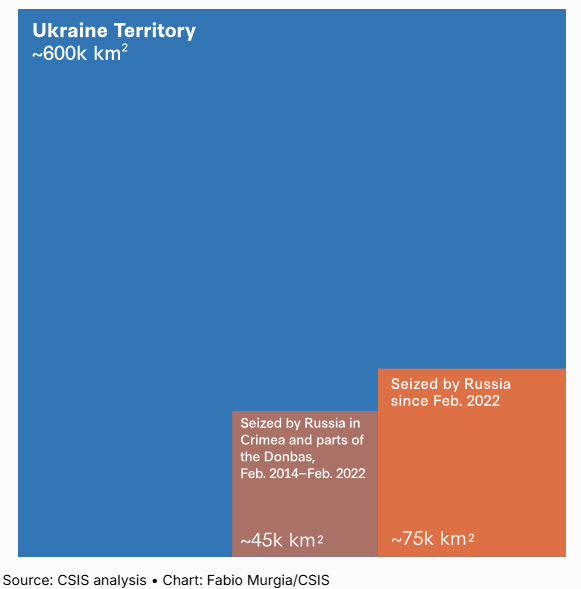
If this war in Ukraine drags on through 2026, Russia is on pace to suffer a similar number of dead, with the grand prize of 1/5th of Ukraine’s (mostly destroyed) territory, about the size of Pennsylvania.
That’s 1/16th of a square kilometer per casualty (a little bit smaller than that chicken farm). That’s not exactly the buffer zone Putin envisioned at the beginning, but only 480K square kilometers to go.
Russian GDP Growth is Beginning to Stagnate
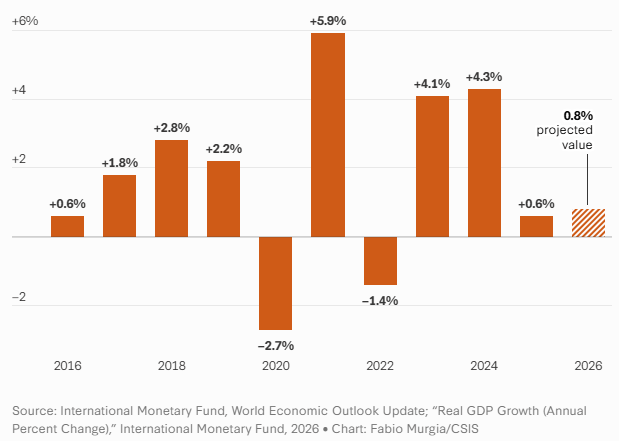
This final chart is the one I hope really lands this plane. The haunting effects of war aren’t just the holes in hundreds of thousands of families that can never be filled again. A war of this magnitude always summons consequences whose impacts will cause suffering for decades after the final bomb detonates.
Those two years of +4.0% GDP growth were driven strictly through massive increases in government spending to fuel the war effort, a short-term drug high with a devastating hangover.
You can grow your economy through two forces: population growth and productivity growth. A healthy economy such as the United States grows both at the same time at modest paces.
Population growth is increased through two means, a birth rate above 2.1 kids per woman or immigration. Russia is hemorrhaging in both areas. Prior to the war, Russian populations had been in severe decline since the collapse of the Soviet Union, dropping from 148 million to 143 million today due to a 1.4 child per woman birth rate, emigration out of the country, and high mortality rates chiefly among males.
This war has accelerated all of the negative points made above. The most obvious being deaths on the battlefield. However, other factors not typically thought of also include lower birth rates due to men being stuck on frontlines for years at a time. Additionally, it’s estimated 3 million young Russians fled the country at the start of the war for greener pastures abroad. To make matters worse, these emigrants were disproportionally more educated and wealthier making their loss even harder to fill.
Then there’s productivity loss. Capital that would otherwise have gone into making the working population more productive has flowed to the war effort. Need capital for next generation AI research? Sorry, it’s needed for that tank production line. Need capital for updating highways and new bridges? Sorry, that’s needed this month’s production of ballistic missiles.
I still haven’t even mentioned the destruction of Russia’s international prestige, its diplomatic relations with the West, and ruin of historic export markets. We’re watching a country mortgage its future for lackluster territorial gains in a European backwater with no end in sight.
***
Putin made his fateful decision based on bad intelligence, an overestimation of Russian capabilities, and hubris. He gambled away Russia’s future in the hopes of reestablishing the old Russian hegemon. As we enter the fifth year of a conflict that was not expected to last longer than 3 days, I have no doubt history will judge him severely. Pandora’s Box of war will always be more difficult to close than open, and the people of Ukraine will suffer the consequences as a result.

 Casual Musings on War
Leave a comment